
The involvement of Valencia in the POWER UP project was a gamechanger for the city to boost community energy in many ways. One major challenge the city tackled and solved was how to enable energy communities to access municipal rooftops in a legally sound and transparent way while ensuring social impact. Under leadership of València Sostenible (formerly Valencia Clima i Energia), the city’s sustainability agency, together with the municipal Valencia Innovation Capital, the municipality reformed its public procurement rules granting energy communities the right to use municipal rooftops for installing solar photovoltaic systems for collective self-consumption. Resident in vulnerable situations are directly benefitting from this new legal framework.
Valencia has committed to reaching climate neutrality by 2030 as part of the EU Mission “100 Climate-Neutral Cities”. Expanding local renewable energy production is therefore a key priority. At the same time, the city has seen increasing interest from citizens willing to form renewable energy communities. Through its Energy Offices, Valencia has been supporting the creation of energy communities for several years now. These initiatives often face barriers such as lack of access to rooftops, complex regulatory frameworks, and limited experience developing energy projects. Meanwhile, municipalities often own buildings with large unused rooftop potential. Valencia identified an opportunity to provide roof access to citizen-led renewable energy projects.
The local solution: A social energy model
By integrating social criteria in the tendering specifications for public roofs, the municipality encourages applications from inclusive energy communities. It provides long-term access to those roofs through a public tender. The selected energy community finances, installs, owns and operates the photovoltaic installation for collective self-consumption. Selected energy communities receive a 25-year concession (extendable up to 30 years) to operate the installations.
The concession does not involve a financial fee to the municipality. Instead, the chosen energy community must provide energy benefits for the public:
- At least 10% of installed capacity must supply municipal buildings
- At least 5% of installed capacity must be reserved for vulnerable households identified by municipal social services
Candidates can score additional points during the tender if they increase these shares beyond the minimum requirements.
Selection criteria in the tender prioritize social value
Proposals are evaluated based on criteria such as:
- Additional energy supplied to vulnerable households
- Additional energy supplied to municipal buildings
- Gender balance in the energy community governance
- Training of board members on energy communities
- Support letters from local organisations
- Quality of the implementation plan
Role of the municipality and partners
València Sostenible (formerly Valencia Clima i Energia), the city’s sustainability agency, together with the municipal Climate Improvement Service acted as planners, facilitators and regulators: theycreated the legal and procurement framework that allows energy communities to operate renewable installations on municipal property.
Together with other departments, the energy team:
- Identified suitable municipal rooftops
- Prepared technical project documentation for each building
- Designed the public procurement framework
- Defined social and governance criteria for selecting energy communities
- Ensured legal compliance with local, regional and national legislation
- Created a transparent bid procedure, allowing any eligible local energy community to apply.
Municipal services involved
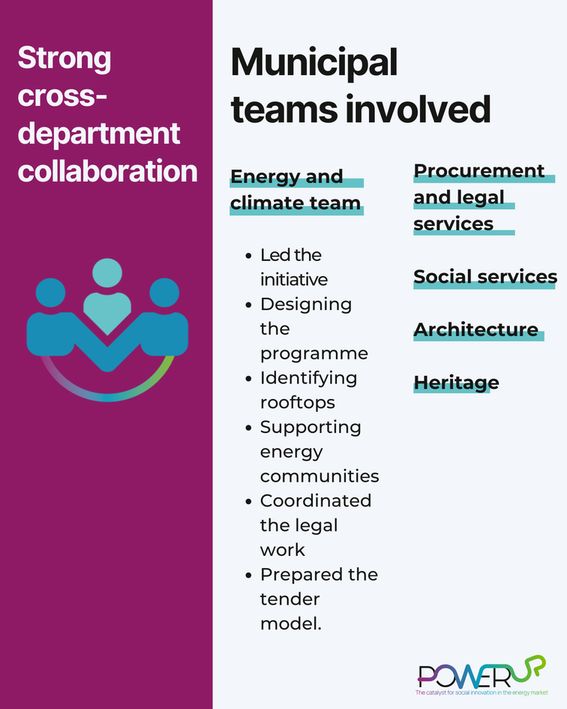
Cross-department collaboration ensured that energy policy, procurement and social policy objectives were aligned. Several municipal departments were involved.
The process behind
The first call launched in 2026 includes three municipal rooftops, divided into three lots:
- A former municipal vehicle depot – 95.6 kWp
- Santa Teresa primary school – 48.9 kWp
- Rosa Llàcer special education centre – 88.5 kWp
In 2025 the City Council approved the concession of public roofs to energy communities safeguarding parts of the produced energy for vulnerable households. But the journey to get there took over two years.
The initiative was prepared through a legal and administrative study carried out in 2023–2024 with support from the administrative and environmental law department of the University of Valencia. This work clarified how regional legislation allows municipalities to tender rooftop access to energy communities and produced a model set of procurement specifications.

What was harder than expected
Developing such an innovative procurement model requires overcoming both technical and institutional challenges.
- Legal novelty: One of the main challenges was updating public asset law to make it fit with community energy projects. The leading team had to navigate internal concerns and resistance to change. Some municipal departments initially expressed concerns about granting long-term access to municipal rooftops. The concession grants use rights for up to 25 years, which raised questions about maintaining control over public assets. To address this, the climate and energy team clarified the public value of the initiative and ensured the concession framework included clear safeguards and responsibilities.
- Technical documentation: Limited technical information on buildings also posed a challenge. To reduce uncertainty for applicants, the municipality commissioned detailed photovoltaic feasibility studies for the selected roofs. These studies provided clear technical guidance for energy communities and ensured installations would comply with structural and electrical requirements.
- Energy community competences: Another challenge was ensuring that energy communities were sufficiently mature to manage installations. To address this, the call required:
- Proof of legal constitution,
- evidence of local members, and
- a detailed work plan covering financing, governance, and community engagement.
What changed in practice thanks to POWER UP?
Valencia’s approach delivers multiple benefits:
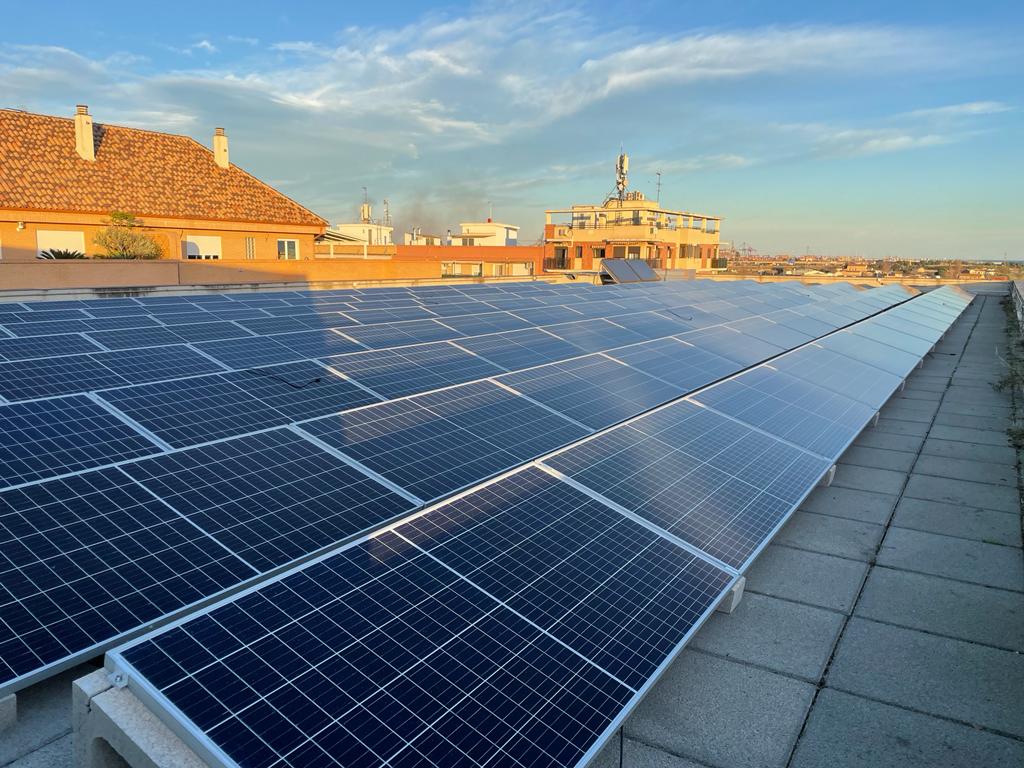
- More renewable energy in the city: More than 230 kWp of solar PV capacity will be installed on municipal buildings.
- Equipped local energy communities: The initiative gives energy communities their first operational assets, helping them grow.
- Social inclusion in the energy transition: Part of the energy produced is allocated to vulnerable households, directly addressing energy poverty and lowering electricity costs for participating households
- Institutional innovation: The city now has a replicable procurement framework for mobilising municipal infrastructure in the energy transition.
View tender details and specifications:
- Spanish and an AI-translated version in English
- Published tender (in Spanish) on the national public procurement platform